Staying Safe in the Surf: What Every Surfer Needs to Know
Surfing is one of the most rewarding things you can do in the ocean. It’s also one of the most humbling. The ocean is extremely beautiful and extremely powerful — and the surfers who enjoy it the longest are the ones who respect it, not fear it. At Kalon Surf, safety is built into everything […]
Surfing is one of the most rewarding things you can do in the ocean. It’s also one of the most humbling. The ocean is extremely beautiful and extremely powerful — and the surfers who enjoy it the longest are the ones who respect it, not fear it.
At Kalon Surf, safety is built into everything we do — from how we select beaches each day to how we train guests in the pool before they ever enter the ocean. Our coaches are lifeguard-trained and stay in the water with you during every session. But good safety habits aren’t just for coached sessions. They’re for every time you enter the water, anywhere in the world.
Here’s what we teach our guests — and what every surfer should know.
Understanding the environment
Most surf accidents don’t happen because of bad luck. They happen because someone entered the water without understanding where they were.
Know your beach
A beach can look beautiful and inviting from the sand, but you have no idea what’s below the surface. Rocks, reef, shallow sandbars, rip channels — locals know these things because they’ve been surfing there for years. You don’t. Before you paddle out at any unfamiliar break, take time to watch the water first. Look at where waves are breaking, where the water is moving sideways, where other surfers are entering and exiting.
Talk to people
This is the simplest and most underused safety tool in surfing. When you’re somewhere new, ask. If there’s a lifeguard, talk to them — ask where it’s safe to swim and surf, where the rips are, what the current is doing. If there’s no lifeguard, talk to local surfers. Ask a surf school. People are generally happy to share this information because it keeps everyone safer.
Watch the flags
Beach flags indicate conditions — red for dangerous, yellow for caution, green for safe. Pay attention to them. Keep in mind that flags aren’t available everywhere in the world, and in Costa Rica specifically, not every beach is monitored. That’s another reason to ask locals.
Study the conditions
Before you surf anywhere, understand the basics: what’s the swell direction and size? What’s the tide doing? Is it going in or out? How big is the tidal range at this location? In Costa Rica, the tidal difference can be up to 14 feet — conditions that are safe at mid-tide can be completely different two hours later.
You also need to understand rip currents. Rips are channels of water flowing back out to sea. They’re not trying to pull you under — they’re pulling you out. If you get caught in one, the single most important rule is: never swim against it. Swim parallel to shore until you’re out of the current, then swim back in. Fighting a rip head-on will exhaust you, and exhaustion in the ocean is dangerous.
Surfing safety and etiquette
Never surf alone
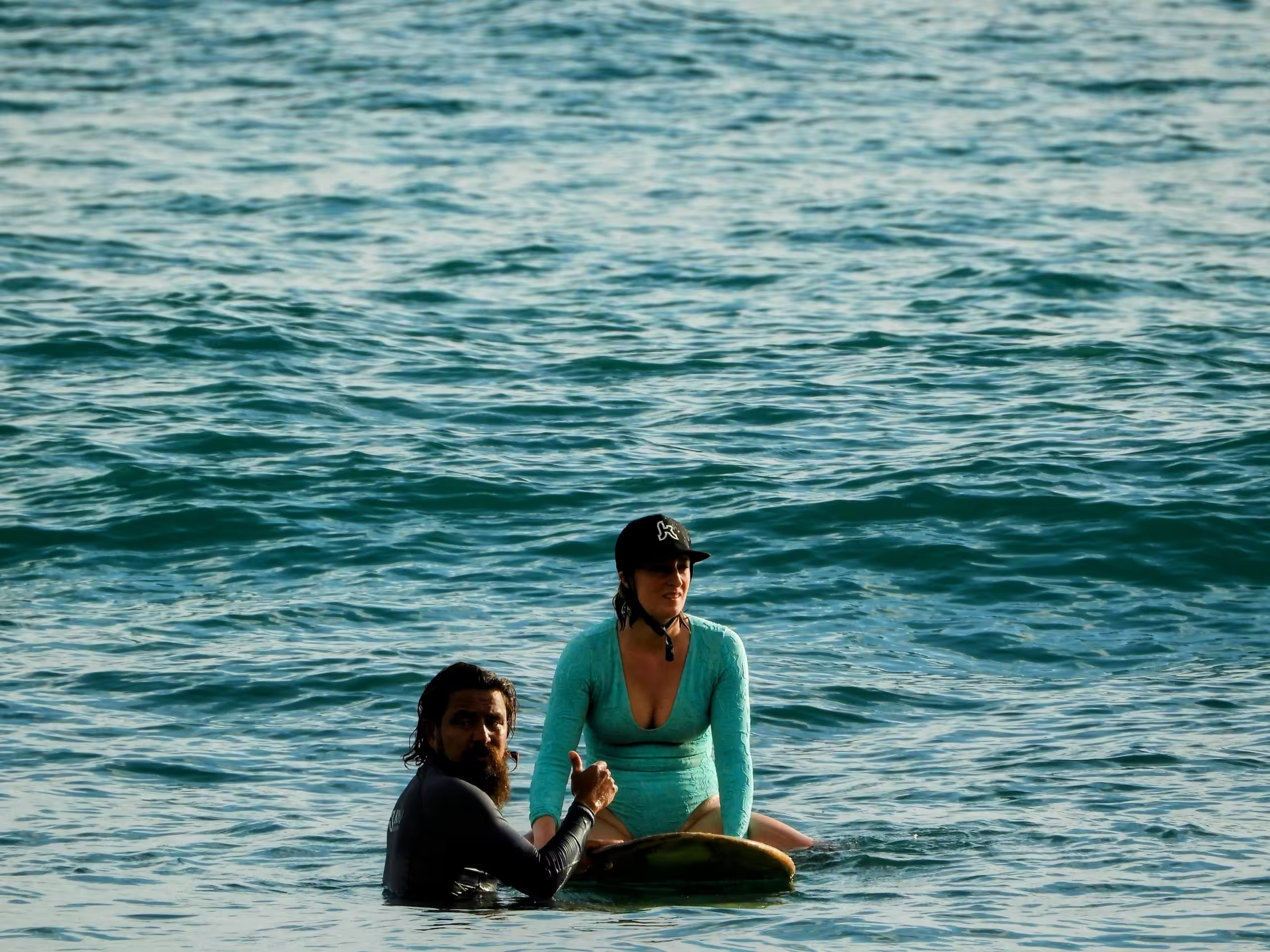
In my opinion, you should always have someone with you in the water. It doesn’t have to be a coach — it can be a friend, another surfer, anyone. But being alone in the ocean means that if something goes wrong — a cramp, a board to the head, getting caught inside on a big set — nobody knows. At Kalon, our coaches are always in the water alongside you. If you’re surfing independently, make sure someone on the beach at minimum knows you’re out there.
Respect the locals
When you’re surfing at a break that isn’t your home break, be respectful. Smile. Say hello. Don’t paddle straight to the peak and start taking waves. Sit on the shoulder, take your turn, and let the people who surf there every day have their waves. If you have a good attitude, there are almost never issues. Where we surf around Dominical, the vibe is relaxed — but that’s partly because we actively choose breaks where our presence doesn’t crowd out locals.
Read the waves
Waves come in sets — groups of waves with lulls in between. Most of the time, waves break in a predictable zone. But “set waves” — the bigger waves that come every few minutes — break further out than the regular waves. If you’re sitting in the lineup and you see a larger wave approaching on the horizon, you need to paddle further out quickly. Getting caught “on the inside” when a set wave arrives means a wall of whitewater landing on your head. Awareness of set patterns is something that develops with time, but you should start paying attention from day one.
The safety position
This is something we teach at Kalon that most surf schools don’t cover. If you’re paddling for a wave and suddenly realize it’s too steep — you’re going to go over the falls — you can protect yourself by sitting all the way back on the tail of the board and gripping both rails as tightly as possible. The wave will pass over you while you hold position. It’s not glamorous, but it keeps you from getting pitched headfirst into shallow water.
Keep your equipment in check
Work on your paddle. The stronger your paddling is, the more control you have — getting into waves, getting out of impact zones, and getting back to shore if conditions change. A strong paddle is your primary safety tool.
Make sure you’re a comfortable swimmer. Leashes break. When yours does — and eventually it will — you need to be able to swim back to shore without your board. If you’re not confident swimming in the ocean without a board, spend time building that skill before surfing bigger waves.
And always wear your leash. It keeps your board attached to you, which means it’s not flying toward someone else’s head.
Breathwork and staying calm
This is the part of surf safety that most people never practice — and it’s the part that makes the biggest difference when things go wrong.
Managing the wipeout
Every surfer wipes out. Beginners, intermediates, professionals — everyone goes under at some point. The natural reaction is to panic, thrash, and try to get to the surface as fast as possible.
Here’s the reality: most wipeouts hold you underwater for one to three seconds. It feels much longer because your adrenaline is spiking and your brain is telling you it’s an emergency. But if you can stay calm, relax your body, protect your head with your arms, and wait for the turbulence to pass — you’ll surface naturally, quickly, and with plenty of air.
What we teach in the pool
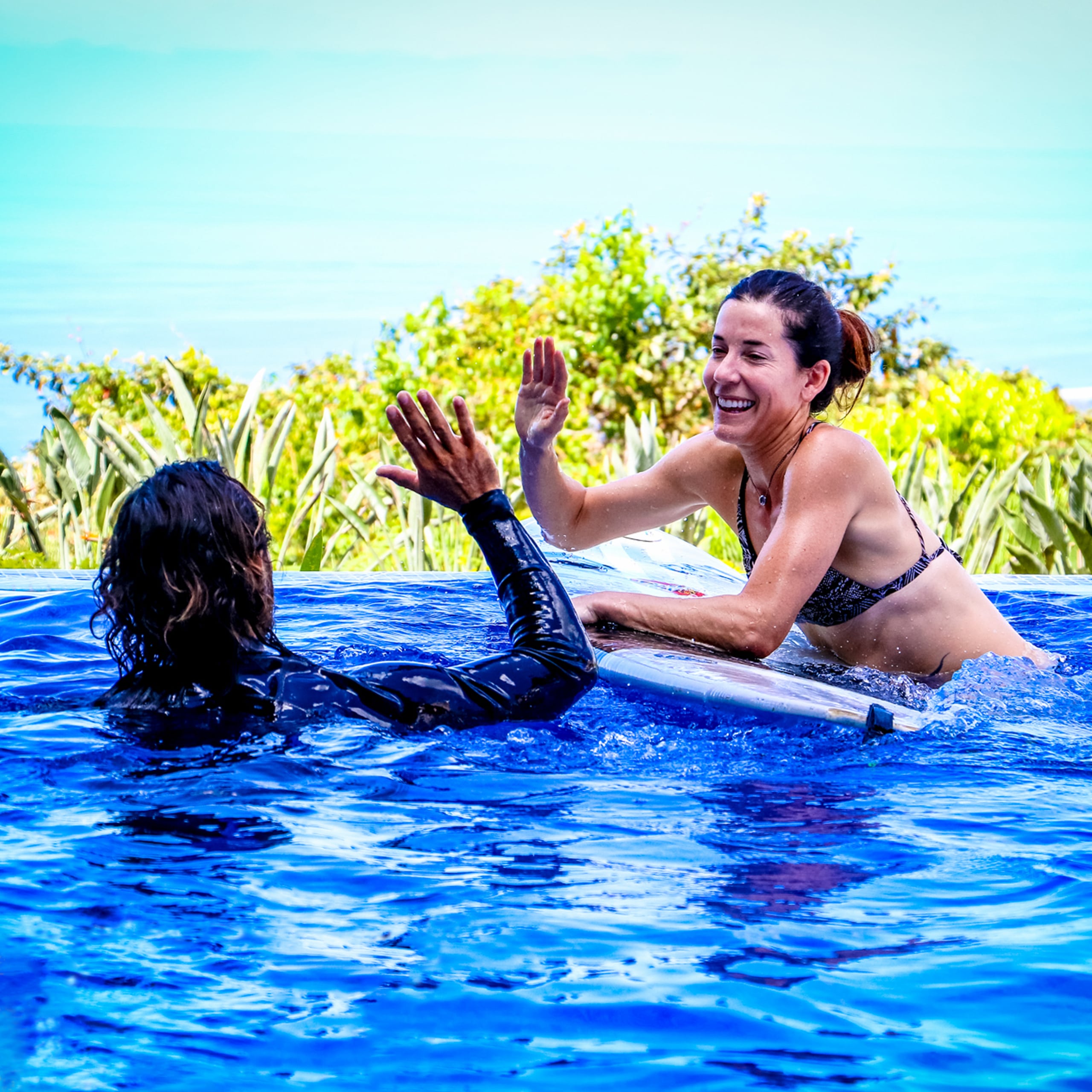
At Kalon, we run breathwork exercises in the pool specifically to prepare guests for this moment. We show people that they can hold their breath much longer than they think. Most guests can comfortably stay underwater for 15 to 20 seconds in the pool — once they realize that, and they understand that a typical wipeout is a fraction of that time, the fear dissolves significantly.
We also teach that panicking and thrashing wastes oxygen rapidly. Moving your arms and legs frantically underwater burns through your air supply in seconds. Staying still, staying relaxed, and letting the wave pass uses almost no oxygen at all. It’s counterintuitive — your instinct says “fight” — but the correct response is to go limp, protect your head, and wait.
Once guests experience this in the pool — feeling how much time they actually have — their confidence in the ocean changes completely. They stop fearing the wipeout, which means they surf more relaxed, which means they surf better, which means they wipe out less. It’s a positive cycle that starts with one simple realization: you have more time than you think.
Breathwork before the session
Simple breathing exercises before you paddle out can also make a difference. A few minutes of controlled deep breathing — slow inhale, slow exhale — lowers your heart rate and puts your nervous system into a calmer state. You’ll paddle out more relaxed, read the water more clearly, and react better if something unexpected happens.
Safety at Kalon
At Kalon, safety isn’t a separate topic from coaching — it’s woven into every part of the week.
Day one includes an ocean safety briefing covering rip currents, surf etiquette, and how to fall safely (never headfirst — arms over your head, fall flat or feet-first). Pool sessions include the breathwork exercises described above. Our coaches check conditions every morning and select the safest appropriate beach for the day’s tide, swell, and guest levels. In the water, we maintain a 3:1 guest-to-coach ratio, with coaches positioned to assist at all times.
We also have a firm policy: alcohol and surfing don’t mix. Surfboards are heavy, fins are sharp, and impaired judgment in the ocean is dangerous. We don’t allow alcohol at the beach or surfing under the influence — enjoy the beer and wine back at the resort, watching the sunset from the pool.
The ocean is powerful. Respecting that power — through knowledge, preparation, and the right coaching — is what lets you enjoy it safely for a lifetime.