We get this question a lot: “What should I do to prepare for my week at Kalon?” People assume the answer is strength training — push-ups, pull-ups, hitting the gym harder. And while being in good general shape doesn’t hurt, the honest answer might surprise you.
The most important thing you can work on before a surf trip isn’t strength. It’s balance.
Fitness doesn’t equal a faster learning curve
After coaching thousands of guests, we can tell you this with certainty: there is no direct correlation between how fit someone is and how quickly they learn to surf. We’ve seen incredibly strong, athletic people struggle more than someone who does casual exercise a few times a week. We’ve had triathletes have a harder time than people who just go for walks and do some yoga.
Why? Because surfing asks your body to do something it’s probably never done before. It’s not about raw power — it’s about technique, flexibility, and balance. Someone who is very strong but not very flexible will have trouble arching their back, moving their foot into position, and rotating their body during the pop-up. Their body is trained to do one thing, and asking it to do something completely different can actually be harder than starting from a more neutral baseline.
So the first piece of advice is: don’t overtrain for what you think surfing requires. You don’t need to show up with a six-pack and arms like a swimmer. Focus on the things that actually help.
Balance is the number one thing
If you could only work on one thing before your surf trip, make it balance. Surfing is fundamentally a balance sport. Everything else — strength, endurance, flexibility — supports your ability to stay balanced on a moving surface.
Simple ways to improve your balance before a trip:
Balance board or wobble board. These are inexpensive and the closest thing to simulating the instability of a surfboard on water. Even 10 minutes a day makes a noticeable difference. If you don’t have one, try standing on one leg while brushing your teeth — it sounds silly but it works.
Yoga. Not just for flexibility (though that helps too) — yoga trains your body to hold positions that require active balance and core engagement. Warrior II, Eagle Pose, and Tree Pose are all directly relevant. We have a full yoga routine for surfers if you want a structured practice.
Skateboarding or snowboarding. If you already do either of these, you’re ahead. The balance mechanics are similar — a moving surface under your feet, lateral weight shifts, bent knees. Even longboarding on flat ground translates well.
Core and flexibility matter more than arm strength
People assume surfing is all about upper body — paddling, push-ups, that kind of thing. And yes, you do paddle. But the movements that actually determine whether you catch waves and stand up are driven by your core and your flexibility.
The one-two-three pop-up requires you to arch your back, open your hips sideways, and slide your front foot through your arms. If your hip flexors are tight, your lower back is stiff, or your core can’t hold you stable during rotation, you’ll struggle — regardless of how much you can bench press.
Work on:
Hip flexibility. Pigeon Pose, deep lunges, hip circles. Tight hips are the number one physical limitation we see in guests, especially people who sit at a desk all day.
Spinal mobility. Cobra Pose, Cat-Cow, gentle back extensions. You need to be able to arch your back comfortably — it’s the “one” in our one-two-three method, and it has a real function: it pushes the board into the water to generate speed.
Core stability. Planks, Boat Pose, dead bugs. Not for a six-pack — for the ability to hold your body stable while everything underneath you is moving.
Legs — more important than you’d think
Your legs do most of the work once you’re standing on a surfboard. And even before you’re standing, they’re working harder than you’d expect.
As a beginner, your first sessions will follow a pattern: walk out through the shallows carrying your board, paddle back in on the whitewater, stand up, ride it out, then walk back out again. That walking-through-water cycle is tiring on the legs, especially in sand and current.
As you progress to longer rides — catching green waves, riding across the face — your legs become even more critical. They absorb the movement of the wave, they drive your turns, they keep you low and balanced. Strong, enduring legs are a real advantage.
Squats, lunges, and wall sits are all useful. Nothing fancy required — just legs that can keep working for a three-to-four-hour surf session.
Swimming helps — but not for the reason you think
If you have access to a pool or live near the coast, swimming is a great way to prepare. But the biggest benefit isn’t fitness — it’s comfort in the water.
People who swim regularly are calmer in the ocean. They’re more relaxed when a wave breaks on them, more comfortable being underwater for a few seconds, and less likely to panic. That calmness translates directly into better surfing, because you’re not fighting the water — you’re working with it.
Swimming also helps with paddle endurance, which is useful. But the mental comfort is the bigger win. If you’re not a confident swimmer, even a few weeks of regular pool laps before your trip will make a meaningful difference.
What you don’t need to worry about
You don’t need to be able to do lots of push-ups. The pop-up isn’t a push-up — it’s a technique movement. Our one-two-three method uses leverage, not brute strength.
You don’t need to be a strong swimmer. Our coaches are in the water with you the entire session, and we choose beaches and conditions appropriate for your level. You should be comfortable in water, but you don’t need to be fast.
You don’t need to be young or athletic. Our oldest first-time surfer was 82. We regularly coach guests in their 50s and 60s who haven’t done anything athletic in years. Technique and coaching close the gap that fitness can’t.
You don’t need a special training program. If you have a few weeks before your trip and want to do something useful: work on balance, stretch your hips and back, do some squats, and go swimming. That’s it. You’ll arrive in great shape for what the week asks of you.
What happens when you get here
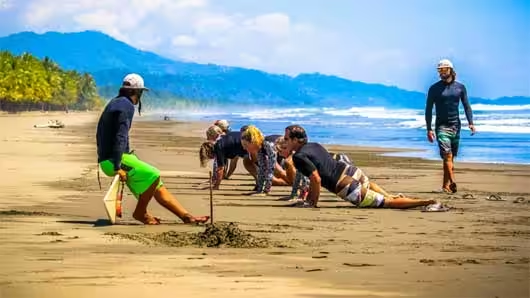
At Kalon, your first day starts in the pool — not the ocean. We teach the pop-up technique on dry land and in the pool before you ever touch a wave. Then we move to the beach for practice on the sand. By the time you’re in the water, your body has already rehearsed the movement dozens of times.
Every session is coached at a 3:1 guest-to-coach ratio, filmed for daily video analysis, and matched to your level with the right board from our Firewire and Slater Designs quiver. After sessions, there’s yoga three times a week and a complimentary massage to help your body recover.
The point is: we meet you where you are. The coaching, the progression, the equipment — it’s all designed so that your fitness level doesn’t limit your experience. Come as you are. We’ll take care of the rest.