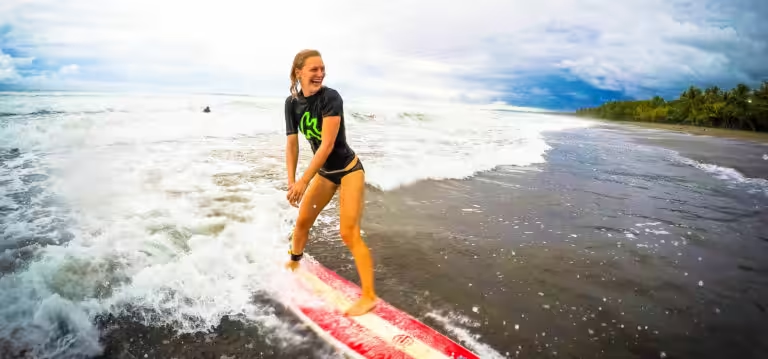
The ocean doesn’t have referees, but it definitely has rules.
Every week at Kalon Surf, we coach a new group of guests — most of whom have never surfed before. And one of the first things we cover (before anyone touches a board) is etiquette. Not because we want to bore you with a lecture, but because understanding how the lineup works is the difference between having a great time and being that person nobody wants to surf near.
Surf etiquette exists for two reasons: safety and respect. A surfboard is heavy, the fins are sharp, and a crowded wave can go wrong fast. But at uncrowded beach breaks like the ones we surf around Dominical, the stakes are lower — which makes it the perfect place to learn these habits early, so they’re automatic by the time you surf anywhere else.
Here are the seven rules our coaches drill into every guest.
1. Don’t snake
Snaking is when you paddle around another surfer to position yourself closer to the peak of the wave — essentially cutting the line to steal priority. It’s the surf equivalent of someone pushing past you in a queue and pretending they didn’t see you.
It happens a lot in crowded lineups. It rarely happens at Kalon (we surf uncrowded breaks with a 3:1 guest-to-coach ratio), but you need to know what it is so you never accidentally do it — and so you can recognize it if someone does it to you.
The rule: Wait your turn. There are plenty of waves. The surfer who was waiting longest or is positioned closest to the peak gets the next one. Patience isn’t just polite in surfing — it’s the whole culture.
2. Respect the right of way
This is the most fundamental rule in surfing, and it’s simple: the surfer closest to the breaking part of the wave (the peak) has priority.
In practice, this means if you’re paddling for a wave and you see someone to your inside (closer to where the wave is breaking), pull back. They have the right of way. It doesn’t matter if you were ready first, paddling harder, or really, really wanted that wave.
How we teach it: Our coaches call this out in real time during your sessions. When you’re watching the daily video analysis back at the resort, you’ll also see the wave from a different angle — which makes it much easier to understand positioning and priority than when you’re in the water and everything feels chaotic.
3. Don’t drop in
Dropping in means taking off on a wave that someone else is already riding. It’s the single fastest way to ruin someone’s wave, damage a board, or cause a collision.
One surfer, one wave, one direction. If someone is already up and riding, that wave belongs to them. Full stop.
This sounds obvious when you read it on a screen. In the water, when a beautiful wave is rolling toward you and adrenaline is pumping, it takes discipline to pull back. But that discipline is what separates a surfer from a kook.
Why it matters beyond etiquette: Surfboards colliding at speed can cause real injuries — lacerations, broken noses, concussions. The fins on the bottom of a board are essentially three small knives. This isn’t about hurt feelings; it’s about not hurting people.
4. The paddler furthest out gets priority
When multiple surfers are paddling for the same wave, the person who’s been sitting deepest (furthest out from shore) or waiting longest generally gets priority.
This is where it gets nuanced. Longboarders can catch waves earlier and further out because their boards have more paddling power. That doesn’t mean they should call priority on every wave and leave shortboarders with nothing. The spirit of the rule is fairness — take your wave, then let the next person have theirs.
At Kalon, this rarely becomes an issue because our coaches manage the lineup and make sure every guest gets plenty of waves. But if you surf on your own after your week with us, this is the rule that keeps lineups civilized.
5. Never ditch your board
Your surfboard is attached to you by a leash. That leash exists so your board doesn’t become a projectile flying toward someone else’s head.
When you fall — and you will fall, a lot, and that’s completely fine — try to maintain some awareness of where your board is. Don’t just bail and let it fly. Hold on if you can, or at minimum fall away from other surfers and keep the board close.
The Kalon context: This is why we practice wipeouts during pool sessions and dry land training before you ever get in the ocean. When falling is rehearsed, it becomes less panicky and more controlled. You learn to protect yourself (arms over your head, don’t dive headfirst) and protect others (board control, spatial awareness).
6. Don’t dive headfirst
This one can save your life, so read it twice.
When you fall off your board, never dive headfirst into the water. You don’t always know what’s below you — sand bars shift, rocks hide under the surface, and the water might be shallower than it looks.
Instead: Fall flat or feet-first. Cover your head with your arms. Let the wave pass over you, then surface carefully. We surf beach breaks (sandy bottom), which is forgiving compared to reef — but even on sand, a headfirst dive into shallow water can cause neck and spinal injuries.
Our coaches demonstrate safe falling technique on the first day, and it’s one of those things that feels overly cautious until you hear a story about someone who got it wrong. Learn to fall well. It’s as important as learning to stand up.
7. Communicate
If you and another surfer are both in position for a wave that breaks both ways (what surfers call an A-frame), talk to each other. One calls “going left,” the other goes right. Two surfers, one wave, no collision — everybody’s happy.
This applies beyond just A-frames. If you’re paddling out and a surfer is riding toward you, make eye contact and commit to a direction — don’t freeze in the middle of the wave like a deer in headlights. Paddle toward the whitewater (behind the surfer), not toward the open face where they’re trying to ride.
The bigger picture: Surfing looks like a solo sport, but it’s deeply communal. The lineup is a shared space. A quick “hey, you go” or “I’m going right” takes half a second and prevents so much grief. The surfers who communicate well are the ones everyone wants to share waves with.
Bonus rule: keep the ocean clean
This isn’t an etiquette rule in the traditional sense, but it matters. If you see trash on the beach or in the water, pick it up. Don’t leave anything behind that you brought. The ocean is everyone’s lineup, and keeping it clean is part of respecting it.
At Kalon, sustainability is built into how we operate — from locally sourced ingredients to reef-safe sunblock to our partnership with Firewire Surfboards, who are leaders in sustainable board manufacturing. But the simplest form of ocean stewardship is personal: leave the beach better than you found it.
How we teach etiquette at Kalon
We don’t just hand you a list of rules and wish you luck. Surf etiquette is woven into the coaching from day one.
On your first evening, during the video analysis session, our coaches show an etiquette video that covers right of way, how to escape rip currents, and how to safely navigate the lineup. Throughout the week, coaches reinforce these rules in the water — calling out situations in real time so you learn to read the lineup instinctively, not just intellectually.
The advantage of learning etiquette at a coached surf retreat vs. figuring it out on your own at a crowded break: you get to make your mistakes in a low-pressure environment with a coach standing right there, instead of getting yelled at by a local who’s had their wave ruined for the third time that morning.
By the time you leave, these seven rules won’t feel like rules anymore. They’ll feel like second nature — which is exactly how they should feel when you paddle out anywhere in the world.