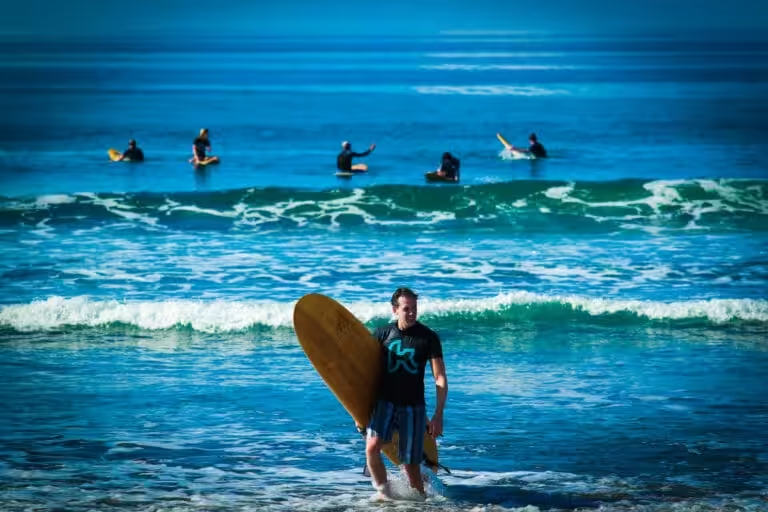
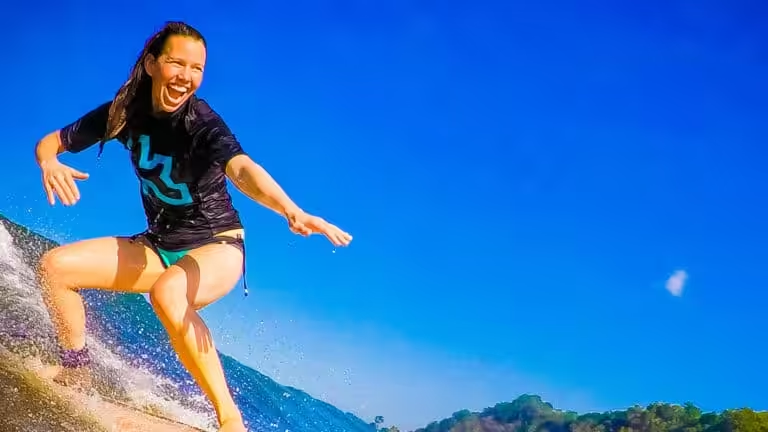
Most of our guests at Kalon Surf have never touched a surfboard before they arrive. By the end of the week, they’re riding green waves and wondering why they didn’t try this ten years ago.
The difference isn’t talent. It’s coaching — and specifically, knowing which mistakes to fix first.
Our surf coaches work with beginners every single week. They see the same patterns, the same habits, and the same breakthroughs. Here are the ten mistakes that trip up almost every new surfer, and exactly how we fix them.
1. Wrong position on the board
This is the first thing our coaches check, and it’s the mistake that causes the most frustration early on.
Your surfboard works like a seesaw. If your weight sits too far forward, the nose dives. Too far back, and you can’t catch anything — you’ll paddle hard and the wave will roll right under you.
How we fix it: Before you even hit the water, your coach will help you find your sweet spot on the board. We use a visual reference point — a logo, a wax mark, whatever’s on the deck — so you can reset to the right position every single time. Once that’s locked in, everything else gets easier.
2. Starting on the wrong board
Every beginner wants to ride what the pros ride. We get it. But a short, narrow board is designed for speed and sharp turns — not for learning balance.
As a beginner, you need volume and width. A board in the 8- to 9-foot range gives you stability, easier paddling, and way more wave-catching power. At Kalon, we provide a full quiver of high-quality boards for every level — including Firewire and Slater Designs shapes for guests who are ready to progress. Your coach will pick the right board for you on day one and may switch you to something smaller mid-week if you’re ready.
3. Skipping dry land practice
This one separates the guests who progress fast from those who plateau early.
Practicing your pop-up on the beach before getting in the water builds muscle memory. It sounds simple, and honestly, it can feel a little awkward doing push-ups on sand while everyone watches. But the guests who commit to land drills always have a smoother time in the water.
How we approach it at Kalon: Dry training is built into our coaching methodology — it’s not optional, and it’s not an afterthought. We use pool sessions too, where you can practice technique in a controlled environment before dealing with waves. This combination of land drills, pool work, and ocean time is what makes progression feel natural instead of frustrating.
4. Paddling straight into whitewater
New surfers tend to paddle directly into the oncoming whitewater. It’s exhausting, it’s demoralizing, and it’s completely avoidable.
How we fix it: Your coach will show you how to read the break and position yourself about five meters from where the waves start to lift — the channel or the edge, not straight through the impact zone. This one adjustment saves you enormous energy and gets you into position faster. Surf etiquette matters here too — knowing where to paddle keeps you out of other surfers’ way.
5. Not being aware of other surfers
The ocean has its own unwritten rules, and ignoring them will get you in trouble fast.
Every surfer takes turns. The person closest to the peak of the wave has priority. Dropping in on someone else’s wave — “snaking” — is the quickest way to earn a bad reputation in any lineup.
How we fix it: We coach ocean awareness from the very first session. Before you paddle for a wave, look both ways. Know who’s around you. At the uncrowded beach breaks we surf, there’s plenty of space to learn without pressure — but building this awareness early means you’ll be a respectful surfer wherever you go.
6. Mistiming the pop-up
Pop-up timing is everything. Too early and the wave hasn’t picked you up yet — you stall. Too late and you’re already in the whitewater, getting pitched forward.
How we fix it: This is about learning to feel the wave’s momentum. You start paddling before the wave reaches you, and the moment you feel it lift the tail of your board and accelerate you forward — that’s your window. Our coaches stand in the water with you during early sessions, calling out the exact moment to go. It’s one of those things that clicks once you feel it, and then it clicks every time.
7. Dropping to a knee during the pop-up
When the wave hits and things feel chaotic, your instinct might be to drop a knee to the board as a halfway step. It feels safe. It’s not — it usually ends in a wipeout, and it builds a habit that’s hard to break later.
How we fix it: We use a color-coded wristband system at Kalon to help each guest focus on one thing at a time. The red band focuses on foot placement: back foot first, front foot center. The green band focuses on step-by-step sequencing — making sure feet go in the right order. By isolating these fundamentals, we train a clean, direct pop-up from the start instead of letting a knee-drop habit form. Stay low, feet slightly wider than shoulder-width, and commit to the movement in one motion.
8. Grabbing the rails during pop-ups
It seems logical — the board is wobbling, so you grab the sides (rails) to stabilize yourself. But gripping the rails tilts the board, shifts your weight, and almost always leads to a wipeout.
How we fix it: Think push-up, not pull-up. Your hands should be flat on the deck, roughly chest-level, and you push your body up and jump both feet into position. This keeps the board level underneath you. Our coaches drill this on the beach first so the motion is automatic by the time you’re in the water.
9. Looking at your feet instead of down the line
Here’s something most beginners don’t realize: your surfboard goes where you look. If you stare at the beach, you’ll ride straight to shore and the wave will close out behind you. If you look down at your feet, you’ll freeze up.
How we fix it: The pink band in our coaching system focuses exactly on this: look where you want to go, look forward. Your body follows your head. When you look down the line of the wave — parallel to the shore — your board naturally tracks that direction, and you ride across the face of the wave instead of getting swallowed by it. This is often the single biggest unlock for guests mid-week.
10. Bending at the waist instead of the knees
Beginners tend to hunch forward at the waist. It feels balanced, but it locks up your hips and limits your ability to absorb the wave’s energy. One bump and you’re off.
How we fix it: The light blue band focuses on this: bend your knees, stay low. Knees bent, weight centered, hips slightly forward. This lowers your center of gravity and gives you the flexibility to react. The orange band adds the final piece — driving your hips forward to maintain speed and keep the board moving. Once guests get this stance dialed in, everything changes. You go from surviving the wave to actually riding it.
How long does it take to fix these mistakes?
It depends on how much time you spend in the water — and how good the coaching is.
At Kalon, we surf five days a week with 3- to 4-hour sessions, combined with daily video analysis where you can see exactly what you’re doing and what needs to change. Most guests go from total beginner to confidently riding green waves within a single week.
If you’re surfing on your own, expect the basics (paddling, catching whitewater waves) to take around 30 hours of practice. Catching and riding green waves can take 100+ hours without structured coaching.
The shortcut? Good coaching, consistent practice, and the right waves for your level. That’s what a surf coaching resort is designed to do — compress months of trial and error into one focused week.
Quick tips to accelerate your progress
Before your trip: Work on your fitness and flexibility. Push-ups, squats, and yoga all help. Swimming builds the paddling endurance you’ll need.
During your sessions: Focus on one thing at a time. Don’t try to fix everything at once — that’s why we use the wristband system. Master foot placement before worrying about turning.
Between sessions: Watch your video analysis carefully. What you eat matters too — surfing burns a lot of energy, and recovery between sessions is key.
After your trip: Keep surfing. The muscle memory you build in a coached week stays with you, but it needs reinforcement. Even a few sessions a month will keep your progression moving forward.
Learn to surf the right way at Kalon Surf
We’re an all-inclusive surf resort in Dominical, Costa Rica — perched at 1,200 feet with ocean views, infinity pools, and some of the best uncrowded beach breaks on the Pacific coast.
Over 60% of our guests are first-time surfers. Whether you’re 40, 50, or 60+ and have never surfed, or you’ve tried a few times and want to actually progress — our coaches will meet you where you are.
Every week includes personalized surf coaching, daily video analysis, pool and dry training sessions, wellness activities, gourmet meals, and the kind of community that makes strangers feel like old friends by Wednesday.