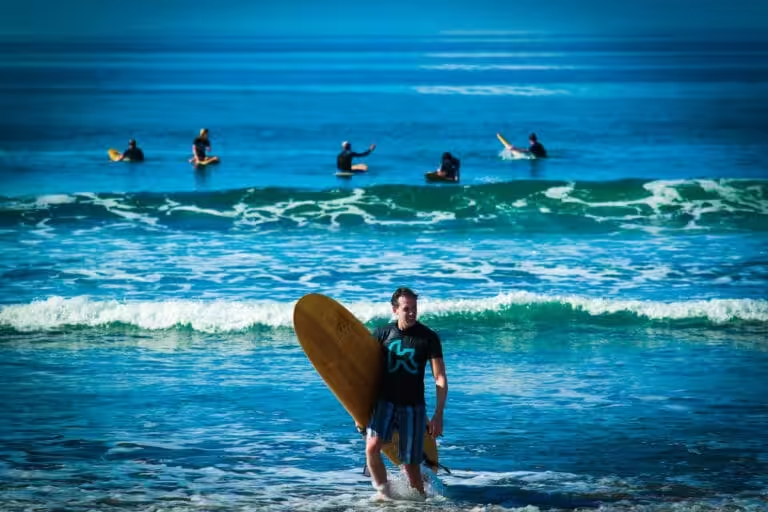
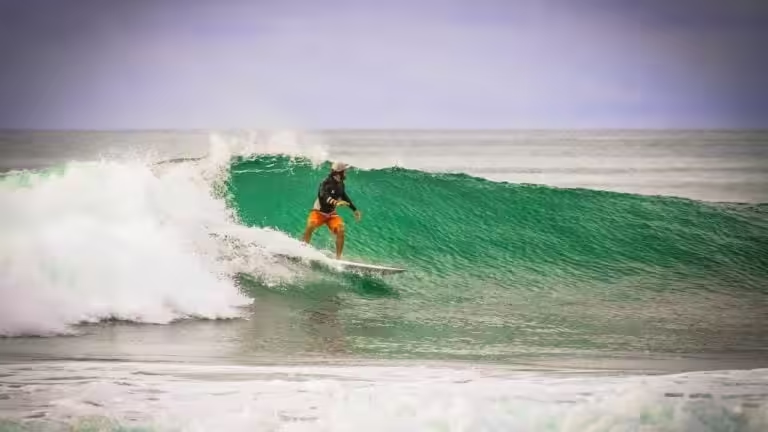
There’s a bit of a mystery around longboards. Most people associate them with beginners — and it’s true, they’re the best board to learn on. But here’s what most beginner surf guides won’t tell you: nearly every experienced surfer eventually comes back to the longboard. Not because they’ve gotten worse. Because they’ve gotten good enough to appreciate what a longboard actually offers.
Why beginners start on longboards
If you’re just learning to surf, a longboard is the right choice. More length means more stability. More width means more float. More volume means easier paddling and earlier wave catching — you’ll catch waves that a shortboard wouldn’t even register.
For beginners, those advantages are everything. You spend less time falling and more time standing, which builds confidence and muscle memory faster.
A few tips for choosing your first board:
Go bigger than you think. Aim for a board that’s about 3 feet taller than you and as wide as possible. More foam under your feet means more forgiveness while you’re figuring things out.
Epoxy or soft-top — either works. Epoxy boards offer better durability and float. Soft-tops are more forgiving when you fall on them (and when they fall on you). Both are great for learning. At Kalon Surf, we provide boards matched to your level — your coach picks the right one on day one.
Don’t spend big money yet. An expensive board doesn’t make you a better surfer. If you’re buying your own, a secondhand longboard is perfectly fine for learning.
How to ride a longboard: step by step
Once you’ve got the right board, here’s the progression:
Pick your spot carefully. Half of a good surf session is choosing the right beach at the right tide. Check conditions before you go — or let your coach handle it. At Kalon, we select the best break each day based on tide, swell, and wind.
Paddle out past the break. Your longboard floats beautifully, but that also means incoming whitewater will push you around. Learn to turtle roll — flip the board upside down, hold on, and let the wave pass over you — to get past the break line efficiently.
Join the lineup and wait your turn. Face the horizon and watch for incoming sets. When you see a wave you want, turn to shore and get into position. Respect surf etiquette — don’t paddle for every wave and don’t cut in front of surfers who were waiting before you.
Paddle with long, powerful strokes. You want to match the wave’s speed. Stay in the lower third of the wave as it approaches. When you feel the tail lift and the board accelerate — give two or three more strong pulls. Don’t stop too early; that’s the most common mistake.
Pop up at two-thirds. When you’re about two-thirds of the way up the wave face, execute your pop-up. Knees bent, weight centered, eyes looking where you want to go — down the line, not at your feet.
That’s the basics. And for most guests at Kalon, this progression — from whitewater to catching green waves — happens within a single week.
Why experienced surfers come back to the longboard
Here’s where it gets interesting.
As surfers progress, they naturally want to move to a shortboard. Shortboards are fast, responsive, and built for sharp turns and high-performance surfing. That progression is exciting, and it should happen.
But for most surfers, there comes a moment — maybe after years of shortboarding — where they pick up a longboard again and something clicks differently. It’s not a step backward. It’s a different experience entirely.
Think of it like the difference between running sprints and going for a longer run through a forest. Sprints are intense, explosive, focused. A long run through beautiful scenery is still a real workout — you’re still moving, still challenging your body — but you’re also present, rhythmic, enjoying the surroundings. You might not hit a heart rate of 180, but you come home feeling great.
Longboarding is like that. It’s more mellow, more flowing. Depending on the conditions, you can use a longboard to genuinely relax on the water — riding longer waves, trimming across the face, walking the board. It’s less about attacking the wave and more about moving with it. Dropping into a wave on a longboard is still a thrill. Taking one out on bigger waves? Incredibly exciting. It’s just a different kind of energy.
When I first started learning about surfing at a surf school in Brazil, we’d watch the waves come in and study the lefts and rights. One of the head coaches there was an extraordinary longboarder, and watching him ride was like watching someone dance on the water. Smooth, fluid, effortless — every movement connected to the next. It changed how I thought about surfing entirely.
The secret: longboarding makes your shortboarding better
This is something a lot of surfers don’t realize, and it’s one of the most valuable things our coaches teach at Kalon.
People tend to think longboarding and shortboarding are two completely separate disciplines. They’re not. Longboarding actually improves your shortboarding — significantly.
On a longboard, you have to learn to move differently. You can’t rely on quick, jerky turns. You have to use your whole body — shifting weight smoothly, cross-stepping, reading the wave further ahead. That forces you to develop a style that’s more fluid, more connected, more intentional.
When you take those movement patterns back to a shortboard, your style looks and feels completely different. Cleaner lines. Smoother transitions. Better flow. The surfers who look effortless on shortboards are almost always surfers who’ve spent time on longboards.
At Kalon, we have a full quiver of Firewire and Slater Designs boards for every level. Your coach might start you on a longboard on day one and move you to a shorter board mid-week as your technique develops. Or, if you’re an experienced shortboarder, they might suggest a longboard session to work on your flow and style. Both directions make you a better surfer.
It’s not a beginner board — it’s a different way to surf
The longboard doesn’t deserve its reputation as the board you graduate from. It’s the board you keep coming back to, at every stage of your surfing life, because it gives you something a shortboard can’t: the feeling of dancing with the wave instead of fighting it.
Whether you’re standing on a board for the first time or rediscovering the longboard after years of shortboarding, the experience is worth it.