Are There Monkeys in Costa Rica? Yes, Four Kinds, and Where You See Them
Yes. Costa Rica has four native monkeys, and the coast decides which you meet. Howlers wake us at dawn above Dominical. All four are declining, and feeding them is against the law.
Guests ask us whether they’ll see monkeys. Yes. Costa Rica has four kinds. Where we live, the howlers wake us at dawn, and monkeys, toucans, and sloths are regular sightings on the property. We can’t promise the species, or the morning.
Which monkeys live in Costa Rica?
Howlers are the ones you hear before you see them. The dawn call carries, so you can know they’re there without a clear look. Capuchins are the white-faced ones, and they live throughout the country, in dry forest, wet forest, and mangroves. They come down to the ground to forage, to drink, and to cross from one patch of trees to the next. Spider monkeys are the fruit eaters of the big forest. Squirrel monkeys are the tiny ones. They travel in big troops and spend most of the day foraging for insects and other small prey.
Which monkeys live on the South Pacific?
A lot of guides write as if the same monkeys live on every coast. The coast decides which ones you meet. The squirrel monkey lives only on the Central and South Pacific side, and from there south into western Panama. Guanacaste is outside that range. The Caribbean is outside it too. Howlers and capuchins are the ones those regions share with this coast.
Where can you see monkeys in Costa Rica?
Corcovado National Park, on the Osa Peninsula, is the park the assessments associate with every species. Howlers, capuchins, and squirrel monkeys are listed there. Spider monkeys are described as believed to occur in Corcovado and on the Osa.
Manuel Antonio is listed for squirrel monkeys and for howlers. Spider monkeys are absent from that park’s list. On the Nicoya Peninsula, biologist Inés Azofeifa said this year that spider monkeys can no longer be seen. A name on a map is not a promise that a troop will be there when you arrive.
What do we see above Dominical?
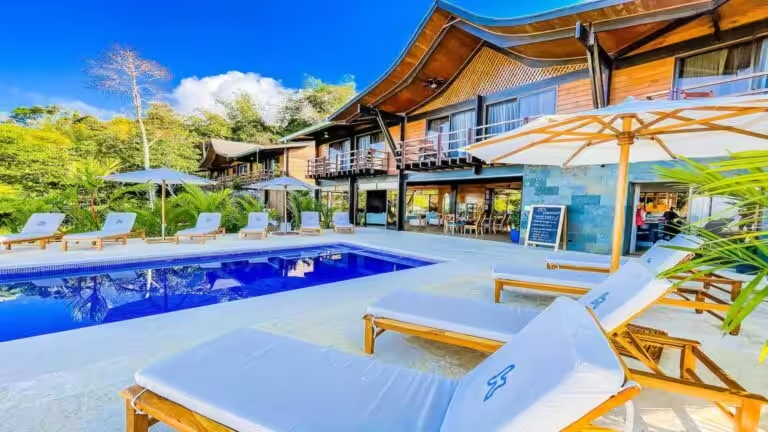
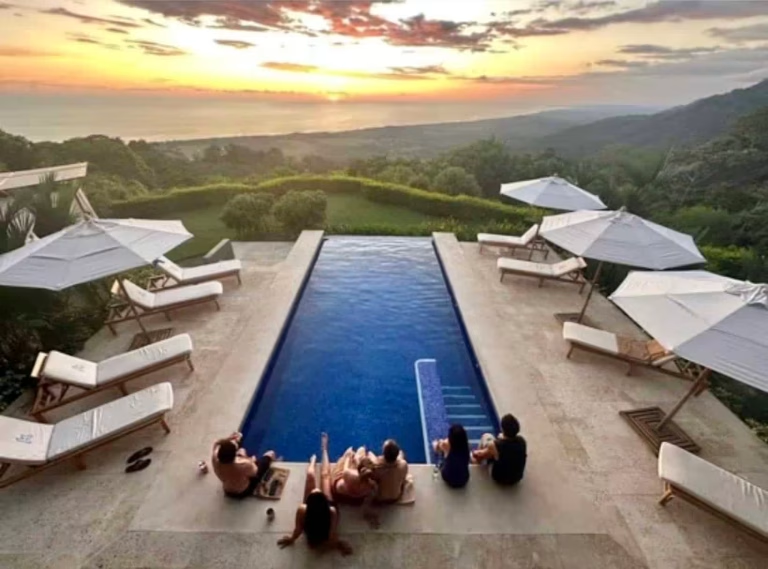
The resort is in the hills above Dominical, on Costa Rica’s South Pacific coast. The property is 7.9 acres, mostly rainforest, and the habitat was never removed. That is why monkeys, toucans, and sloths are regular sightings. A trail leads from the grounds straight into primary rainforest. Howlers at dawn are how the morning starts, and anything beyond that call is up to the forest.
Are Costa Rica’s monkeys endangered?
Three of the four are endangered at the species or the subspecies level, and every one of them is declining. The squirrel monkey and the spider monkey are endangered as species, and the howler subspecies in Costa Rica is endangered too. The capuchin is vulnerable. The Red List suspects the squirrel monkey has fallen by at least 50 percent over the last three generations. For that species it names forest cleared for crops, oil palm, and teak, along with power lines, roads, and the pet trade. Road kills are part of that account, mainly in the Central Pacific and in the south as well.
Between Dominical and Uvita, rope bridges are going up over the coast highway so animals can cross in the trees. This year the Alturas Wildlife Rescue Center and the electric company had half of the bridges they planned already in place. Capuchins and howlers are among the animals expected to use them, along with sloths and anteaters.
Is it illegal to feed a monkey in Costa Rica?
Yes. Give food, or any other unauthorized substance, to a wild animal without permission from the conservation authority, and the wildlife law fines you 15 to 30 percent of a reference salary. It applies everywhere, not only inside the national parks.
The environment ministry and the tourism board ask for photographs at a safe distance that respect the habitat and the animal’s natural behavior. Hugs, petting, or offering food for a picture are inappropriate and illegal.
A monkey that gets fed learns to come to people for food. A report this year described capuchins taking human food at Manuel Antonio and on the Papagayo Peninsula, and a troop approaching tourists for food at Playa Blanca, in Punta Leona. Those are places where people have fed them. Keep your food packed away, and take any photo from a distance. If a monkey comes close, leave the food packed and give it room.
If a monkey bites you, wash the wound with plenty of soap and water and get to a health center as soon as you can. A clinician decides what comes next. The health ministry says rabies in wild mammals on land, including monkeys, has never been confirmed in Costa Rica. It also says surveillance is scarce and the true situation is unknown. A bite still goes to a clinic.
Come for the dawn call and the walk into the forest, keep the food in the bag, and take the photo from a distance. If you want to see how a week with us is arranged, the days are set out there.
Common Questions
Can you see all four monkeys at Manuel Antonio?
Are there squirrel monkeys in Guanacaste?
Are monkey selfies illegal in Costa Rica?
What time of day are monkeys active in Costa Rica?
Written by the team at Kalon Surf, the resort Kjeld and Silene founded in the hills above Dominical in 2011.